Spooky VHS Security Camera Monitor
Created byNibo
v4.5
2D Shader
CreatedJul 13, 2026
UpdatedJul 13, 2026
About this shader
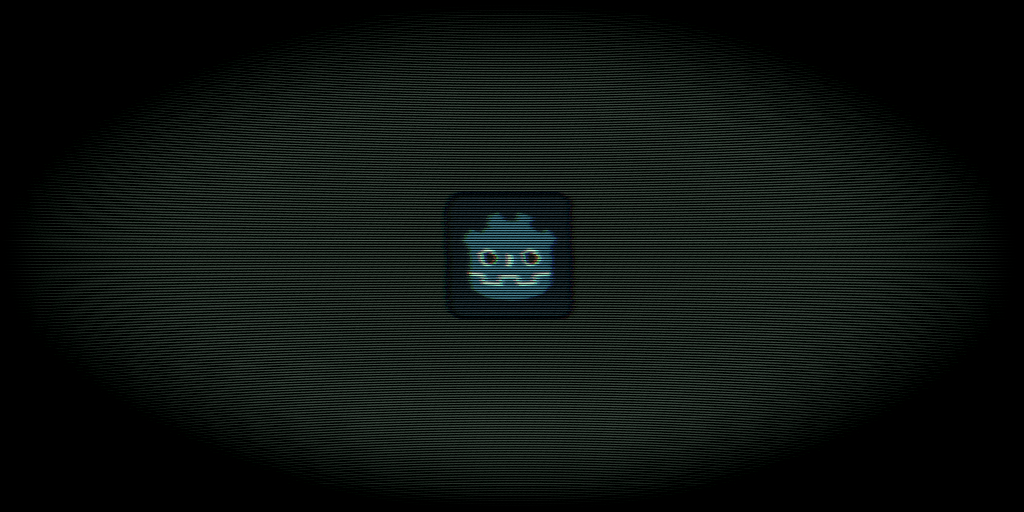
A horror-themed post-processing shader that transforms your Godot scene into a haunted VHS security camera feed. Features CRT barrel distortion, heavy chromatic aberration (RGB ghosting), scanlines, tape wobble, random jitter, rolling tracking bars, tape grain, white specks, signal dropouts with static bursts, flickering brightness pulses, vignette, glow/bloom, and spooky color tints (night-vision green + decay yellow).
Perfect for horror games, found-footage scenes, creepy surveillance rooms, or any project needing that unsettling analog terror aesthetic.
HOW TO USE:
1. Add a CanvasLayer to your scene
2. Add a ColorRect as a child of the CanvasLayer
3. Set ColorRect Layout → Full Rect (anchors to entire screen)
4. Create a ShaderMaterial on the ColorRect
5. Paste this shader code
6. Set ColorRect → Mouse → Filter → Ignore (so it doesn't block UI clicks)
7. Place your UI on a higher CanvasLayer (e.g., CanvasLayer 1) so it renders clean on top
The shader reads from hint_screen_texture, so it only affects whatever is drawn BEHIND the ColorRect. All parameters are exposed as uniforms for easy tweaking in the Inspector.
Shader Code
shader_type canvas_item;
render_mode unshaded;

/*
	============================================================================
	SPOOKY VHS SECURITY CAMERA MONITOR SHADER
	============================================================================
	For Godot 4.3+ (CanvasItem / full-screen post-process)

	This shader simulates a haunted/malfunctioning VHS security camera monitor.
	Perfect for horror games, found-footage scenes, or creepy surveillance rooms.

	Features:
	- CRT barrel distortion with rounded corners
	- Heavy chromatic aberration (RGB split)
	- Scanlines + interlacing flicker
	- VHS tape wobble, jitter, and tracking errors
	- Rolling tracking bars
	- Tape grain, noise, and white specks
	- Occasional frame drops / signal loss
	- Spooky green night-vision tint option
	- Vignette + screen glow
	- Random "ghost" flickers and brightness pulses

	Layering Note:
	This shader uses hint_screen_texture + SCREEN_UV, so it only affects
	whatever is drawn BEHIND this ColorRect.

	For clean UI/HUD:
	- Put this shader on CanvasLayer 0
	- Put your UI on CanvasLayer 1 (or higher)
	============================================================================
*/

// The screen texture we read from (already rendered frame behind this rect)
uniform sampler2D screen_texture : hint_screen_texture, repeat_disable, filter_nearest;

// ============================================================================
// COLOR & TONE CONTROLS
// ============================================================================

// Overall brightness of the image
uniform float brightness : hint_range(0.0, 3.0) = 1.0;

// Contrast adjustment (1.0 = normal)
uniform float contrast : hint_range(0.0, 3.0) = 1.15;

// Saturation (0.0 = grayscale, 1.0 = normal, >1.0 = oversaturated)
uniform float saturation : hint_range(0.0, 2.0) = 0.65;

// Gamma correction
uniform float gamma : hint_range(0.2, 3.0) = 1.2;

// ============================================================================
// SPOOKY TINT OPTIONS
// ============================================================================

// Enable spooky green night-vision tint (0 = off, 1 = full)
uniform float night_vision_tint : hint_range(0.0, 1.0) = 0.35;

// Enable sickly yellow/brown decay tint (0 = off, 1 = full)
uniform float decay_tint : hint_range(0.0, 1.0) = 0.0;

// Overall color temperature shift (-1 = cold blue, 1 = warm orange)
uniform float color_temp : hint_range(-1.0, 1.0) = -0.15;

// ============================================================================
// CRT GEOMETRY
// ============================================================================

// How much the screen bulges outward (barrel distortion)
uniform float curvature : hint_range(0.0, 0.5) = 0.12;

// How soft the rounded screen corners are
uniform float corner_soften : hint_range(0.0, 0.3) = 0.08;

// Vignette darkness at the edges (0 = none, 1 = very dark)
uniform float vignette_strength : hint_range(0.0, 1.0) = 0.5;

// ============================================================================
// SCANLINES
// ============================================================================

// How dark the scanlines are (0 = invisible, 1 = very dark)
uniform float scanline_strength : hint_range(0.0, 2.0) = 0.85;

// How many scanlines per screen height
uniform float scanline_density : hint_range(0.5, 4.0) = 1.2;

// Interlacing flicker effect strength
uniform float interlace_strength : hint_range(0.0, 1.0) = 0.3;

// ============================================================================
// VHS / TAPE ARTIFACTS
// ============================================================================

// Horizontal chromatic aberration (RGB channel split in pixels)
uniform float chroma_shift_px : hint_range(0.0, 10.0) = 2.5;

// Vertical chromatic aberration (extra spooky)
uniform float chroma_shift_y_px : hint_range(0.0, 5.0) = 0.5;

// Horizontal smear / ghosting (pixels)
uniform float luma_smear_px : hint_range(0.0, 10.0) = 3.0;

// Per-line horizontal jitter (random twitch per scanline)
uniform float jitter_px : hint_range(0.0, 8.0) = 2.0;

// Slow sine-wave wobble across the screen
uniform float wobble_px : hint_range(0.0, 12.0) = 2.5;

// How fast the wobble moves
uniform float wobble_speed : hint_range(0.0, 5.0) = 1.0;

// ============================================================================
// NOISE & GRAIN
// ============================================================================

// General tape grain intensity
uniform float tape_noise : hint_range(0.0, 1.0) = 0.3;

// Random horizontal tracking lines
uniform float tracking_lines : hint_range(0.0, 1.0) = 0.4;

// White speck intensity (dead pixels / tape damage)
uniform float white_specks : hint_range(0.0, 1.0) = 0.15;

// ============================================================================
// ROLLING BAR
// ============================================================================

// Speed of the rolling tracking bar
uniform float roll_speed : hint_range(0.0, 2.0) = 0.08;

// Brightness of the rolling bar
uniform float roll_strength : hint_range(0.0, 0.8) = 0.2;

// ============================================================================
// SPOOKY FLICKERS
// ============================================================================

// Random brightness flicker intensity
uniform float flicker_strength : hint_range(0.0, 1.0) = 0.15;

// How often flickers happen (higher = more frequent)
uniform float flicker_frequency : hint_range(0.0, 10.0) = 2.0;

// Random signal dropout (screen goes to static)
uniform float dropout_chance : hint_range(0.0, 1.0) = 0.02;

// How long dropouts last
uniform float dropout_duration : hint_range(0.0, 1.0) = 0.3;

// ============================================================================
// GLOW & BLOOM
// ============================================================================

// Glow strength on bright areas
uniform float glow_strength : hint_range(0.0, 2.0) = 0.3;

// Brightness threshold for glow
uniform float glow_threshold : hint_range(0.0, 1.0) = 0.6;

// ============================================================================
// UTILITY FUNCTIONS
// ============================================================================

// Simple 1D hash function for pseudo-random numbers
float hash11(float n) {
	return fract(sin(n) * 43758.5453123);
}

// 2D hash function for noise
float hash12(vec2 p) {
	return fract(sin(dot(p, vec2(127.1, 311.7))) * 43758.5453123);
}

// Smooth noise function for more organic randomness
float noise(vec2 p) {
	vec2 i = floor(p);
	vec2 f = fract(p);
	f = f * f * (3.0 - 2.0 * f); // Smoothstep interpolation
	float a = hash12(i);
	float b = hash12(i + vec2(1.0, 0.0));
	float c = hash12(i + vec2(0.0, 1.0));
	float d = hash12(i + vec2(1.0, 1.0));
	return mix(mix(a, b, f.x), mix(c, d, f.x), f.y);
}

// Apply CRT barrel distortion to UV coordinates
vec2 crt_curve(vec2 uv, float k) {
	// Convert UV to centered coordinates (-1 to 1)
	vec2 cc = uv * 2.0 - 1.0;
	// Calculate distance squared from center
	vec2 d = cc * cc;
	// Apply barrel distortion
	cc *= 1.0 + k * vec2(d.y, d.x);
	// Convert back to 0-1 range
	return cc * 0.5 + 0.5;
}

// Check if UV is inside the 0-1 screen bounds
float inside01(vec2 uv) {
	return step(0.0, uv.x) * step(uv.x, 1.0) * step(0.0, uv.y) * step(uv.y, 1.0);
}

// Apply brightness, contrast, saturation, and gamma
vec3 apply_color_controls(vec3 color) {
	// Brightness
	color *= brightness;

	// Contrast (centered around 0.5)
	color = mix(vec3(0.5), color, contrast);

	// Saturation
	float luma = dot(color, vec3(0.2126, 0.7152, 0.0722));
	color = mix(vec3(luma), color, saturation);

	// Gamma
	color = pow(max(color, vec3(0.0)), vec3(1.0 / max(gamma, 0.0001)));

	return color;
}

// Sample the screen texture at given UV
vec3 sample_screen(vec2 uv) {
	return textureLod(screen_texture, uv, 0.0).rgb;
}

// ============================================================================
// MAIN FRAGMENT FUNCTION
// ============================================================================

void fragment() {
	// Get screen pixel size and resolution
	vec2 px = SCREEN_PIXEL_SIZE;
	vec2 res = 1.0 / px;

	// Current time
	float t = TIME;

	// Start with screen UV coordinates
	vec2 uv = SCREEN_UV;

	// ------------------------------------------------------------------------
	// SPOOKY FLICKER EFFECT
	// Random brightness pulses that make the image feel unstable
	// ------------------------------------------------------------------------
	float flicker_time = floor(t * flicker_frequency * 10.0);
	float flicker_random = hash11(flicker_time);
	float flicker = 1.0 - flicker_strength * step(0.85, flicker_random) *
	                  smoothstep(0.0, 0.1, fract(t * flicker_frequency));

	// ------------------------------------------------------------------------
	// SIGNAL DROPOUT (random static bursts)
	// Simulates the tape losing signal briefly
	// ------------------------------------------------------------------------
	float dropout_time = floor(t * 3.0);
	float dropout_random = hash11(dropout_time * 73.0);
	float dropout = step(1.0 - dropout_chance, dropout_random);
	float dropout_fade = smoothstep(0.0, dropout_duration, fract(t * 3.0));
	float dropout_active = dropout * (1.0 - dropout_fade);

	// ------------------------------------------------------------------------
	// VHS LINE JITTER
	// Each scanline gets a random horizontal offset
	// ------------------------------------------------------------------------
	float y_line = floor(uv.y * res.y);
	float jitter_seed = y_line + floor(t * 12.0) * 37.0;
	float jitter_random = hash11(jitter_seed);
	float jitter = (jitter_random - 0.5) * 2.0;
	uv.x += jitter * jitter_px * px.x;

	// ------------------------------------------------------------------------
	// SLOW WOBBLE
	// A sine wave that slowly distorts the image horizontally
	// ------------------------------------------------------------------------
	float wobble = sin(uv.y * 6.0 + t * wobble_speed) * wobble_px * px.x;
	uv.x += wobble;

	// ------------------------------------------------------------------------
	// CRT BARREL DISTORTION
	// ------------------------------------------------------------------------
	vec2 cuv = crt_curve(uv, curvature);
	float in_bounds = inside01(cuv);

	// ------------------------------------------------------------------------
	// ROUNDED CORNERS / SOFT SCREEN EDGE
	// ------------------------------------------------------------------------
	vec2 corner_distance = abs(cuv - 0.5) * 2.0;
	float edge = max(corner_distance.x, corner_distance.y);
	float corner_mask = 1.0 - smoothstep(1.0 - corner_soften, 1.0, edge);

	// ------------------------------------------------------------------------
	// CHROMATIC ABERRATION (RGB SPLIT)
	// Red and blue channels are offset horizontally and vertically
	// This is the classic "ghostly" VHS look
	// ------------------------------------------------------------------------
	vec2 chroma_offset_x = vec2(chroma_shift_px * px.x, 0.0);
	vec2 chroma_offset_y = vec2(0.0, chroma_shift_y_px * px.y);

	float red   = sample_screen(cuv + chroma_offset_x + chroma_offset_y).r;
	float green = sample_screen(cuv).g;
	float blue  = sample_screen(cuv - chroma_offset_x - chroma_offset_y).b;

	vec3 color = vec3(red, green, blue);

	// ------------------------------------------------------------------------
	// LUMA SMEAR / HORIZONTAL GHOSTING
	// Bright pixels leave trails behind them
	// ------------------------------------------------------------------------
	float smear = luma_smear_px * px.x;
	vec3 smear_right = sample_screen(cuv + vec2(smear, 0.0));
	vec3 smear_left  = sample_screen(cuv - vec2(smear, 0.0));
	vec3 smeared = (color + smear_right + smear_left) / 3.0;
	color = mix(color, smeared, 0.4);

	// ------------------------------------------------------------------------
	// SCANLINES
	// Dark horizontal lines across the screen
	// ------------------------------------------------------------------------
	float scanline_wave = sin(cuv.y * res.y * 3.14159 * scanline_density);
	float scanline_darkening = 0.5 - 0.5 * scanline_wave;
	float scanline_mult = 1.0 - scanline_strength * scanline_darkening;
	color *= scanline_mult;

	// ------------------------------------------------------------------------
	// INTERLACING FLICKER
	// Every other line flickers slightly, simulating old CRT interlacing
	// ------------------------------------------------------------------------
	float field = mod(floor(FRAGCOORD.y) + floor(t * 60.0), 2.0);
	color *= 1.0 - interlace_strength * field * 0.15;

	// ------------------------------------------------------------------------
	// ROLLING TRACKING BAR
	// A bright bar that slowly rolls down the screen
	// ------------------------------------------------------------------------
	float roll_y = fract(t * roll_speed);
	float roll_dist = abs(cuv.y - roll_y);
	float roll_bar = smoothstep(0.25, 0.0, roll_dist);
	color += roll_bar * roll_strength * vec3(0.15);

	// ------------------------------------------------------------------------
	// RANDOM HORIZONTAL TRACKING LINES
	// Thin lines that appear randomly across the screen
	// ------------------------------------------------------------------------
	float line_seed = y_line * 0.5 + floor(t * 8.0) * 13.0;
	float line_random = hash11(line_seed);
	float tape_line = smoothstep(0.99, 1.0, line_random) * tracking_lines;
	color += tape_line * vec3(0.2);

	// ------------------------------------------------------------------------
	// TAPE GRAIN / NOISE
	// ------------------------------------------------------------------------
	float grain_noise = hash12(FRAGCOORD.xy + vec2(t * 100.0, t * 80.0));
	float grain = (grain_noise - 0.5) * 2.0;
	color += grain * tape_noise * 0.08;

	// ------------------------------------------------------------------------
	// WHITE SPECKS (tape damage / dead pixels)
	// ------------------------------------------------------------------------
	float speck_noise = hash12(FRAGCOORD.xy * 0.6 + t * 35.0);
	float speck = smoothstep(0.998, 1.0, speck_noise);
	color += speck * white_specks * 0.4;

	// ------------------------------------------------------------------------
	// SIGNAL DROPOUT STATIC
	// If dropout is active, mix in heavy static noise
	// ------------------------------------------------------------------------
	if (dropout_active > 0.0) {
		float static_noise = hash12(FRAGCOORD.xy + t * 500.0);
		vec3 static_color = vec3(static_noise);
		color = mix(color, static_color, dropout_active * 0.8);
	}

	// ------------------------------------------------------------------------
	// CHEAP GLOW / BLOOM ON BRIGHT PIXELS
	// ------------------------------------------------------------------------
	vec3 center = color;
	vec3 glow_r = sample_screen(cuv + vec2(px.x, 0.0));
	vec3 glow_l = sample_screen(cuv - vec2(px.x, 0.0));
	vec3 glow_u = sample_screen(cuv + vec2(0.0, px.y));
	vec3 glow_d = sample_screen(cuv - vec2(0.0, px.y));

	vec3 blur = (center + glow_r + glow_l + glow_u + glow_d) / 5.0;
	float blur_luma = dot(blur, vec3(0.2126, 0.7152, 0.0722));
	vec3 glow = max(blur - vec3(glow_threshold), vec3(0.0));
	color += glow * glow_strength * (0.5 + 0.5 * blur_luma);

	// ------------------------------------------------------------------------
	// VIGNETTE
	// Darkens the corners and edges
	// ------------------------------------------------------------------------
	vec2 vig_uv = cuv - 0.5;
	float vignette = smoothstep(0.9, 0.2, dot(vig_uv, vig_uv) * 2.5);
	color *= mix(1.0 - vignette_strength, 1.0, vignette);

	// ------------------------------------------------------------------------
	// SPOOKY COLOR TINTS
	// ------------------------------------------------------------------------

	// Night vision green tint
	vec3 night_vision = vec3(0.2, 0.9, 0.3);
	color = mix(color, color * night_vision, night_vision_tint);

	// Decay / sickly brown-yellow tint
	vec3 decay_color = vec3(0.9, 0.75, 0.4);
	color = mix(color, color * decay_color, decay_tint);

	// Color temperature shift
	vec3 warm = vec3(1.1, 0.95, 0.8);
	vec3 cool = vec3(0.8, 0.9, 1.1);
	vec3 temp_shift = mix(cool, warm, color_temp * 0.5 + 0.5);
	color *= temp_shift;

	// ------------------------------------------------------------------------
	// APPLY FLICKER
	// ------------------------------------------------------------------------
	color *= flicker;

	// ------------------------------------------------------------------------
	// COLOR GRADING (brightness, contrast, saturation, gamma)
	// ------------------------------------------------------------------------
	color = apply_color_controls(color);

	// ------------------------------------------------------------------------
	// FINAL MASKING
	// Fade to black outside the curved screen and rounded corners
	// ------------------------------------------------------------------------
	color *= in_bounds * corner_mask;

	// Output the final color
	COLOR = vec4(color, 1.0);
}
Live Shader Preview
This feature is currently in beta.
Keep exploring
Related shaders
More community shaders with similar tags and compatibility.
Community Discussion
0Join the discussion! Log in to share your thoughts.
Log In to Comment